Judge Davis in the District Court will be hearing a terrorism case involving individuals from the group al-Shabaab starting next Monday, July 18. The trial is likely to receive national attention.
The terrorism trial in Judge Davis' courtroom will actually start next Tuesday, July 19. The motions in limine will be heard on Monday, but the opening statements will occur on Tuesday.
Judge Davis' courtroom is on the 15th floor of the Federal Courthouse. The courthouse is located at 300 South Fourth Street, Minneapolis, MN 55415.

Friday, July 15, 2011

Should Porn be Allowed in Prisons?
Stumbled across this interesting blog post on whether porn should be allowed in prisons.
Some folks argue that it should, because sexuality is a basic right and it is cruel and unusual to deny people sexuality. As many persons in prison are heterosexual, and prisons are usually segregated by sex, this argument sees porn as a method of sexual release for prisoners.
Other folks say porn, or at least some kinds of porn, should not be allowed in prisons, because it can be violent and objectifying. People often end up in prison because of violent and/or objectifying behavior, and so this argument sees porn or at least violent porn as impeding reform and rehabilitation of prisoners.
The blog post is talking about Kyle Richards' case against the State of Michigan, protesting the policy in his county jail that outlaws pornography. Richards argues that the anti-porn policy in the county jail violates the First Amendment.
In a particularly controversial recent story, a man accused of making child pornography and child rape reviews his own child pornography while in jail. Because he is representing himself pro se, he has a right to review the films in order to prepare his defense.
Some folks argue that it should, because sexuality is a basic right and it is cruel and unusual to deny people sexuality. As many persons in prison are heterosexual, and prisons are usually segregated by sex, this argument sees porn as a method of sexual release for prisoners.
Other folks say porn, or at least some kinds of porn, should not be allowed in prisons, because it can be violent and objectifying. People often end up in prison because of violent and/or objectifying behavior, and so this argument sees porn or at least violent porn as impeding reform and rehabilitation of prisoners.
The blog post is talking about Kyle Richards' case against the State of Michigan, protesting the policy in his county jail that outlaws pornography. Richards argues that the anti-porn policy in the county jail violates the First Amendment.
In a particularly controversial recent story, a man accused of making child pornography and child rape reviews his own child pornography while in jail. Because he is representing himself pro se, he has a right to review the films in order to prepare his defense.
Thursday, July 14, 2011
Hamlet, As Performed by Real Murderers
Another hit from This American Life: Act V. The official tagline:

Another cast member celebrates his participation in Hamlet as his opportunity to escape the social pressures of prison life and to learn about another culture.
And, at the heart of it all, there's Hamlet's timeless question, which the cast members daily bring to life: are we forever the prisoner's of our actions?
We devote this entire episode to one story: Over the course of six months, reporter and TAL contributor Jack Hitt followed a group of inmates at a high-security prison as they rehearsed and staged a production of the last act—Act V—of Hamlet.
(The Cast)
The show asks, what can one more production of Hamlet possibly reveal about murder, revenge, and guilt that millions of previous productions haven't? When the cast members are themselves murderers and other violent criminals, Hamlet can actually take on new meaning. The cast members of a top-security Missouri prison explore aspects of prison life, and their selves, in their discussions over performing in the play with reporter Jack Hitt.
One cast member tells how he came to better understand his own violent history, and the pain of being a victim of violence, through playing the role of the Ghost of the King.
Big Hutch, who plays Horatio, criticizes the plot of Hamlet on the grounds that Hamlet's struggle with whether or not to take revenge, because he says there is no real conflict: Hamlet committed to killing his uncle the minute his father died. Instead, he describes how Hamlet should happen, using the prison as a setting to create a real moral conflict for the character.
Another cast member celebrates his participation in Hamlet as his opportunity to escape the social pressures of prison life and to learn about another culture.
And, at the heart of it all, there's Hamlet's timeless question, which the cast members daily bring to life: are we forever the prisoner's of our actions?
Tuesday, June 28, 2011
Cake Eating Criminals: Using the Criminal Justice System to Get Health Care
An interesting article from ABA Journal:
Defendant Says He Robbed a Bank to Get Prison Health Care
A North Carolina man who robbed a bank proved to be a cooperative criminal.Interesting conversation has cropped up in the comments section, too. One commenter criticizes Verone's actions as twisting the criminal justice system into a form of freeloading. See Comment 19 from "Hard Worker":
James Verone passed a note to the teller that asked for a dollar. Then he sat down and waited for police to arrive, WCNC.com reports. Verone wanted to get arrested to get prison health care.
Verone says he doesn’t have a job and doesn’t have any money. He has two ruptured disks, a growth on his chest, and a problem with his left foot. He told WCNC in a jailhouse interview that he’s getting good heath care now, although the prison doctor accused him of manipulating the system.
"[This is the] first time I've ever been in trouble with the law,” Verone said in the interview from the Gaston County Jail posted on WCNC’s website. “I'm sort of a logical person and that was my logic. [That was] what I came up with.”
Verone, 59, had hoped to spend three years in jail until he is released and begins collecting Social Security. He hopes to move to Myrtle Beach and buy a condominium at that time. Because he only asked for $1, though, he may not get as much jail time as he is seeking.
What bothers me is the general sentiment in our country right now that if somebody wants something it should just be given them. The American Dream is that you are provided the opportunity to pursue happiness…not merely given it.And Comment 30, also from "Hard Worker":
I just don’t think it is ever justified to break the law in order to get what you want…no matter how “just” you believe your reason may be. We live in a society of law, and I don’t think he is justified in what he did.Still, others laud Verone as highlighting massive problems with U.S. health care. See Comment 29, from "This guy is awesome. This country is sad":
I hope more and more people do this and other absurd acts to get healthcare so the rest of the world can see how greedy and selfish our government and wealthy top 5% of this country are.And Comment 31 from the same:
If there is something wrong in this country and it’s laws, then by god people must act, legal or not. Laws are not morals.And Comment 15 from "AndytheLawyer":
Of the 22 first world nations on earth, only the USA lacks a national health.Is this about access to the ingredients essential to the pursuit of happiness, or is this a form of civil disobedience too erosive to the structure of justice in the U.S. to tolerate? What should the judge do with this? Thoughts?
As for #7—In an age with unemployment hovering at 10% and newly created joblets not providing health benefits, “Get a job and pay for it yourself” sounds a lot like “Let them eat cake.”
Monday, June 27, 2011
Habeas Schmabeas and the End(?) of Guantanamo
January 22, 2009: President Obama orders the detention facilities at Guantanamo Bay, Cuba to close within a year.
But 172 detainees still remain in custody today.
You can see this information, and an graphically illustrated history of the Guantanamo detention facility, on the New York Times' Guantanamo Docket.
Guantanamo is a symbol of the hot debate surrounding the detention and treatment of suspected terrorists. At the heart of the issue we encounter challenging questions about how far we are willing to compromise the rights of detainees - both citizens and non-citizens - for the sake of security.
One such right, Habeas Corpus, pops up frequently in detention cases. Habeas Corpus, the right of a person to compel a justification of the lawfulness of their detention before a court, is so fundamental to protecting people from the abuse of governmental power that the founders wrote it right into the Constitution. Constitutional Law texts invariably Hamdan, Hamdi, and Boumediene as the key, recent detention cases featuring a writ of Habeas Corpus. These three cases had the overall effect of reinforcing the right of all persons, citizens and non-citizens and suspected terrorists alike, to petition for habeas corpus, regardless of whatever Congress' terrorism defense legislation says.
I found the the award winning This American Life radio show episode "Habeas Schmabeas" particularly valuable because it stepped past legal form and statistics and asked for the perspectives of persons who actually experienced detention for suspected terrorism. It tied high falutin expressions of constitutional law in with real peoples' stories.

From the official description:
The TAL episode leans towards a critical view of U.S. authorities overseeing terrorist detention programs, but that doesn't make that the right or even the best response to these stories, and to terrorist investigation in general. What do you think?
But 172 detainees still remain in custody today.
You can see this information, and an graphically illustrated history of the Guantanamo detention facility, on the New York Times' Guantanamo Docket.
Guantanamo is a symbol of the hot debate surrounding the detention and treatment of suspected terrorists. At the heart of the issue we encounter challenging questions about how far we are willing to compromise the rights of detainees - both citizens and non-citizens - for the sake of security.
One such right, Habeas Corpus, pops up frequently in detention cases. Habeas Corpus, the right of a person to compel a justification of the lawfulness of their detention before a court, is so fundamental to protecting people from the abuse of governmental power that the founders wrote it right into the Constitution. Constitutional Law texts invariably Hamdan, Hamdi, and Boumediene as the key, recent detention cases featuring a writ of Habeas Corpus. These three cases had the overall effect of reinforcing the right of all persons, citizens and non-citizens and suspected terrorists alike, to petition for habeas corpus, regardless of whatever Congress' terrorism defense legislation says.
I found the the award winning This American Life radio show episode "Habeas Schmabeas" particularly valuable because it stepped past legal form and statistics and asked for the perspectives of persons who actually experienced detention for suspected terrorism. It tied high falutin expressions of constitutional law in with real peoples' stories.
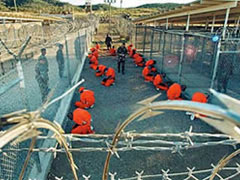
From the official description:
The right of habeas corpus has been a part of our country's legal tradition longer than we've actually been a country. It means that our government has to explain why it's holding a person in custody. But now, the War on Terror has nixed many of the rules we used to think of as fundamental. At Guantanamo Bay, our government initially claimed that prisoners should not be covered by habeas—or even by the Geneva Conventions—because they're the most fearsome enemies we have. But is that true? Is it a camp full of terrorists, or a camp full of our mistakes?My favorite part of the episode is hearing the poem the detainees shared around with each other - it's towards the end, but it's worth the listen.
The TAL episode leans towards a critical view of U.S. authorities overseeing terrorist detention programs, but that doesn't make that the right or even the best response to these stories, and to terrorist investigation in general. What do you think?
Subscribe to:
Posts (Atom)